On a wet afternoon, an energetic child can make a home feel very small. When active kids are stuck inside, the urge to move does not switch off, and it often shows up as climbing the dining chairs or leaping off the arm of the sofa. The good news is that you do not have to spend the day saying stop. With a few simple changes, you can give that energy a safe place to go.
Climbing and balancing are not just ways to burn off steam. They are the kind of big-movement play that helps children build spatial awareness, core stability, and the coordination that lets the two sides of the body work together. By setting up a few low-to-the-ground movement stations indoors, you can protect your furniture and give your child the input their body is asking for.
Why active kids need to climb
When children climb and balance, they are working their two hidden movement senses: the vestibular sense, which tracks balance and where the head is in space, and the proprioceptive sense, which tracks where the body is and how much force the muscles are using. Feeding both through play does a few useful things at once.
- Core and grip strength. Pulling their own body weight up and over things strengthens the hands, shoulders, and stomach muscles, the same muscles that later help a child sit comfortably at a desk.
- Motor planning. Working out where to put a hand or a foot to reach the next step asks the brain to plan a movement before making it, which builds the link between thinking and doing.
- Steadier balance. Balancing on a surface that gives a little teaches the body to adjust quickly, which over time tends to mean fewer wobbles and bumps.
Here are five safe, low setups you can put together at home for a child who needs to move.
Setup 1: The low foam mountain range
For younger children, or for anyone just getting confident with heights, hard timber frames can feel like a lot. A soft setup takes the worry out of it.
Using firm, high-density foam blocks, line up steps, wedges, and sturdy rectangular pieces in order of rising height to make a small climbing ridge on the living-room floor. Because dense foam holds its shape rather than sinking, children can scramble over the peaks and slide down the wedges, getting plenty of firm, grounding input with very little risk of a hard landing.
Setup 2: The stepping-stone balance trail
This one is all about steady balance, ankle strength, and looking ahead to plan the next step. It rewards careful, controlled movement rather than a flat-out run.
Lay out a path of low, stable surfaces across the room. Non-slip stepping stones work well, and so do flat cushions or the square cushions from a modular play set. Space them just far enough apart that your child has to reach or take a small step from one to the next without touching the floor in between. To make it harder, vary the heights, or add a low, slightly wobbly foam beam in the middle so the core muscles have to switch on to keep things steady.
Setup 3: The climbing arch and cushion cave
Pairing a sturdy climbing frame with soft foam underneath gives you the best of both: a place to climb and a snug spot to settle straight afterwards.
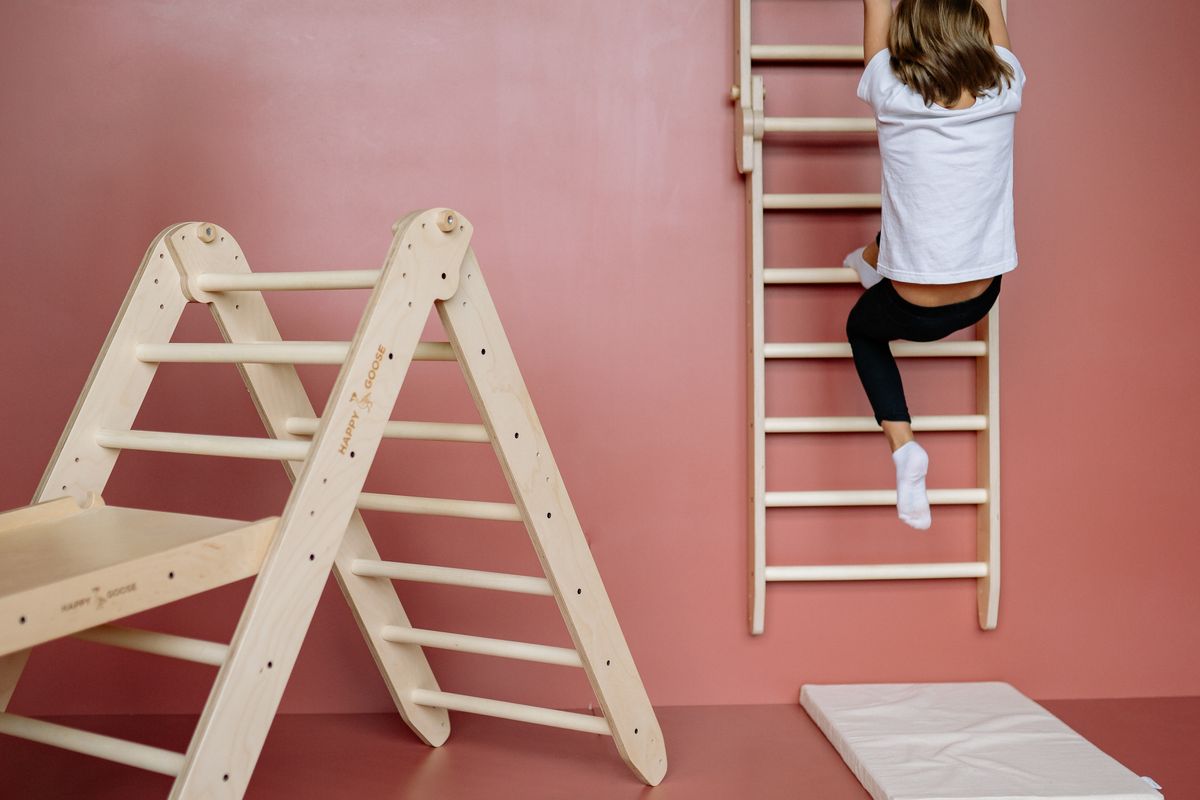
Set a low wooden climbing arch or a Pikler triangle over a padded play mat. Tuck a couple of soft cushions or a foam base underneath to make a little cave. Children can climb up and over the rungs to build grip and confidence, then crawl down into the enclosed space below for a quiet moment. Always check that the frame is stable and sized for your child before they climb.
Setup 4: The incline challenge
A gentle slope gives an active child a satisfying sense of height without anything tall to fall from.
Prop a firm, non-slip foam ramp securely against a low, stable base, such as a sturdy step or a stacked set of foam cubes, and make sure it cannot slide. Have your child crawl up the slope on all fours, a move that gives the shoulders and hips a good dose of heavy work, then slide or roll gently back down. Stay close and spot them on the first few goes so they learn the limits of the setup.
Setup 5: The full obstacle course
The best way to stretch motor planning is to keep changing the layout, so the brain has to work out a fresh route each time rather than running on memory.
Combine your pieces into a loop. A simple sequence might be:
- Crawl through a pop-up fabric tunnel or an open-ended box.
- Walk carefully along a low balance beam or a line taped to the floor.
- Jump into a soft landing zone made of a crash pad or a thick foam mattress.
- Climb up and over a low step-and-wedge pyramid.
Time each run, or turn it into a story where your child is crossing a jungle or a space station. Set the rule that the course only runs when an adult is nearby, and keep the landing zone clear and soft.
The takeaway
Indoor climbing and balance play do not have to mean a chaotic house. With the right mix of stable frames and firm, supportive foam, you can set aside a small movement zone that keeps your child safe, builds their confidence, and gives their body the input it needs to settle. Keep it low to the ground, keep the landings soft, and stay close while they find their feet.